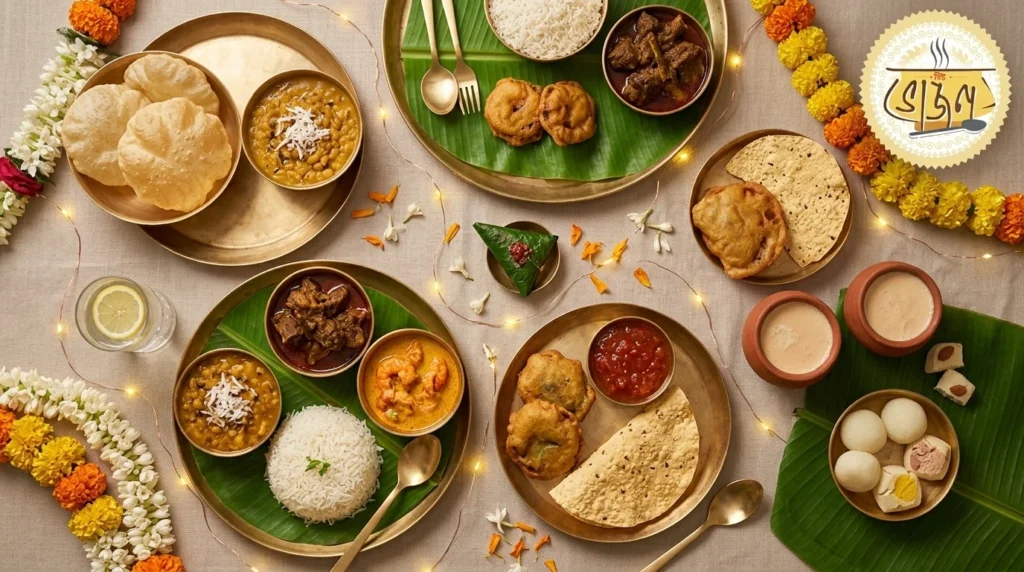
Quick Answer: A Bengali wedding (বিয়ে বাড়ি) serves food across these courses — street food counters (fuchka, papri chaat), fried starters (fish fry, cutlets), rice or luchi with dal and vegetables, fish dishes (shorshe ilish, chingri malai curry, bhetki paturi), kosha mangsho or biryani, and a finale of mishti (rosogolla, sandesh, mishti doi). Pricing runs ₹640–₹1,100/plate depending on menu tier.
There's an old saying that at a Bengali wedding, people remember the food longer than they remember the flowers. And honestly? It's true. We've catered enough biye bari events in Kolkata since 2006 to know — guests forgive a late start, they tolerate a tight venue, but they won't forget bad fish fry. Or cold kosha mangsho. Or mishti doi that wasn't set right.
The Bengali wedding menu isn't just a list of dishes. It's a sequence, a sentiment, a cultural statement. Every course has a place. Every dish carries expectation. The chholar dal has to taste like home. The ilish needs to sing with mustard. And the rosogolla at the end? It should close the evening the way a perfect sentence closes a paragraph — completely.
So this guide exists to help you plan a biye bari menu the right way. We'll go through every course in order, name every dish worth including, explain what to spend where, and give you pricing so you're not going in blind. This is the guide we wish every family got before they started calling caterers.
Read this in Bengali? Our full বাঙালি বিয়ের ক্যাটারিং মেনু গাইড ২০২৬ is available at that link.
What Food Is Served at a Bengali Wedding?
Direct answer: A Bengali wedding serves food across these main categories: street food counters (ফুচকা, papri chaat), hot starters (fish fry, cutlets, kababs), rice or luchi/kochuri with dal and vegetables, fish dishes (শর্ষে ইলিশ, চিংড়ি মালাই কারি), mutton dishes (কষা মাংস, biryani), and a full mishti spread (রসগোল্লা, সন্দেশ, মিষ্টি দই, পায়েস). The meal closes with পান (mukhshuddhi). Pricing ranges from ₹640 to ₹1,100 per plate depending on menu tier.
Bengali wedding food is different from other regional cuisines in one important way. Fish isn't a side dish here — it's the star of the meal. The whole menu builds toward the fish course, and everything after it winds down into sweets. That structure is deliberate, cultural and non-negotiable for a proper traditional spread.
Modern biye bari menus have evolved, of course. Live counters are everywhere now. North Indian dishes appear in the starter section regularly. Some families add a pasta station. But underneath all of that, the core Bengali sequence remains — and any caterer worth booking knows how to hold that structure together.
Bengali Biye Bari Menu — Traditional Sit-Down Structure
The original Bengali wedding feast was a sit-down meal, served on banana leaves (পাত পেড়ে) in long rows. Guests sat on the floor or on low wooden seats. Servers walked up and down, placing each item course by course. Nothing was served all at once. The sequence was strict.
That tradition is still alive at some high-ceremony weddings, particularly in older South Kolkata families and in rural West Bengal. But most modern biye bari events in Kolkata have moved to a semi-buffet format: a main buffet counter for rice, luchi, dal, vegetables and meat, combined with dedicated starter counters, live food stations and a separate sweet section. It works faster for large guest counts, and guests can control their own portions.
But — and this matters — the course sequence should still be respected even in a buffet format. You don't put the mishti doi at the start. You don't serve kosha mangsho before the fish course. A good caterer will guide you on this. The pacing of a biye bari feast is part of what makes it feel authentic.
Here's the complete course structure, section by section.
Street Food & Starter Counters (ফুচকা, চাট, কাটলেট, মাছ ভাজা)
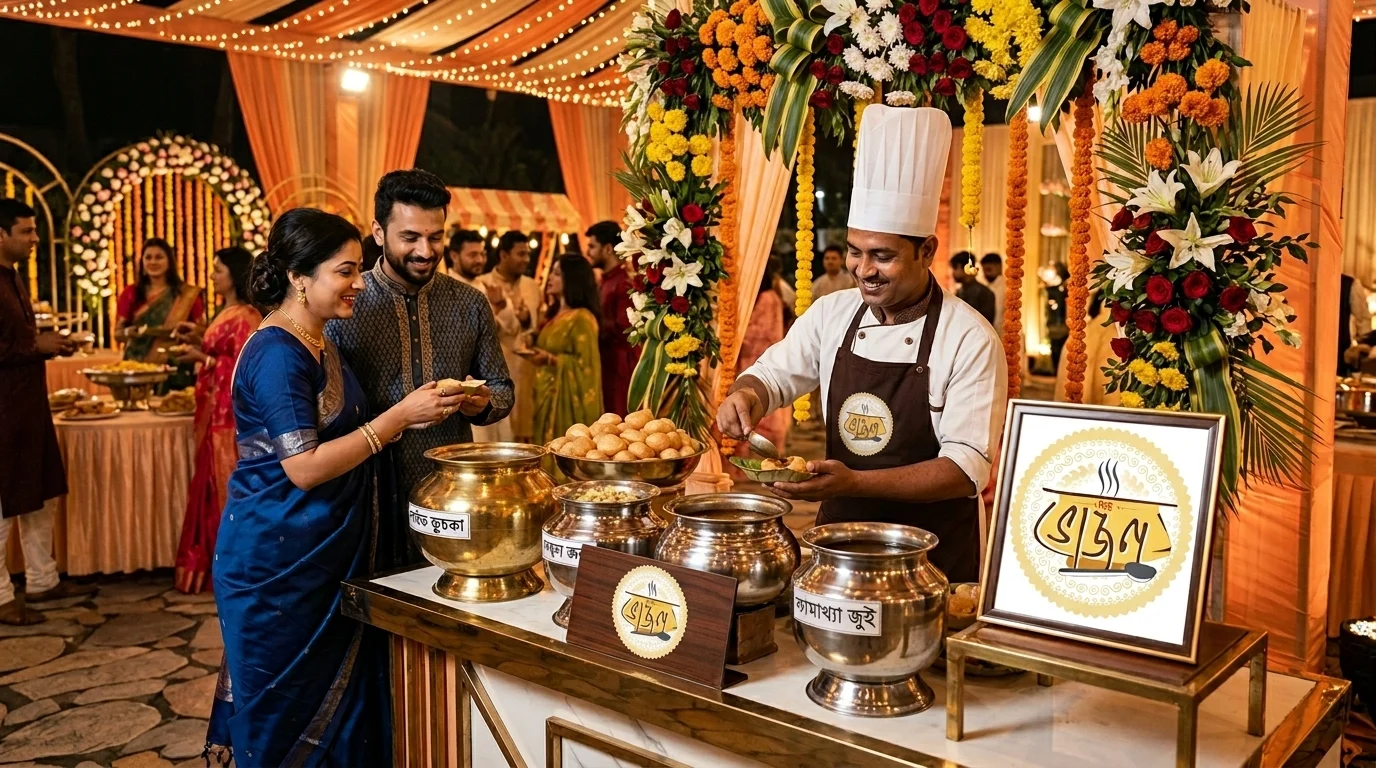
The biye bari starts long before anyone sits down for the main meal. As guests arrive and mingle, the starter section is already running. And at every proper Kolkata wedding, the fuchka counter goes first.
- Fuchka (ফুচকা) is non-negotiable. Crispy hollow puris filled with spiced mashed potato, tamarind water, and a hit of green chilli — served by a dedicated counter chef directly into your hands. Guests line up for it every single time. It doesn't matter if they're coming from Salt Lake, Newtown or South Kolkata. The fuchka counter draws a crowd. Plan for a live fuchka station rather than plated pre-made fuchka — the freshness and theatre of it is half the experience.
- Papri chaat / Doi puri — Delhi-influenced but long adopted into Kolkata biye bari culture. Crispy papri wafers with yoghurt, tamarind chutney, sev and spice. Usually served at a separate chaat counter alongside fuchka.
- Fish fry (ভেটকি ফিশ ফ্রাই) — Bhetki fish fillets, lightly coated and deep-fried, served hot from the kitchen. This is the starter guests remember most. If the fish fry is cold, they'll mention it. If it arrives sizzling, they'll come back twice. Time the batches right — it's the single most important operational call in the starter section.
- Cutlet — Usually veg (aloo cutlet or mixed vegetable) or non-veg (chicken cutlet, macher chop). Served with kasundi — the mustardy Bengali condiment that no other chutney can substitute.
- Gandhoraaj Fish Tikka — Freshwater fish marinated in spices with Gandhoraaj lemon (a Bengali lime variety with a distinct floral fragrance), grilled to order. This is a trending starter at premium Kolkata weddings and adds a distinctly local flavour that guests notice.
- Kababs — Chicken reshmi kabab, seekh kabab or paneer tikka round out the starter section at most mid-range and premium events. These usually come from a separate tandoor or grill counter.
- Veg starters — Paneer pakora, crispy corn, dahi bora (fried lentil balls in yoghurt) — all popular for mixed or vegetarian-leaning guest lists.
- Mocktails / welcome drinks — Often placed at the entry point before guests even reach the food area. Aam panna (raw mango drink), jal jeera, virgin mojito and fruit punches are common. Some caterers now run live coffee stations with espresso and cappuccino — especially popular at evening events.
Rice & Bread — ভাত ও রুটি
The rice and bread section is where the main meal begins. Most biye bari menus offer one rice option and one bread option simultaneously on the buffet.
- Basanti Pulao (বাসন্তী পোলাও) is the Bengali wedding rice. Saffron-yellow, mildly sweet, perfumed with whole spices, and finished with ghee — it's deeply tied to the aesthetic of a biye bari. If your menu only has one rice item, make it basanti pulao. It pairs with almost every Bengali fish and meat dish.
- Ghee bhat (ঘি ভাত) or plain rice is the secondary option at most events — for guests who prefer a neutral base. Plain steamed rice with a drop of ghee is what older family members tend to gravitate toward, especially with chholar dal and a Bengali fish curry.
- Luchi (লুচি) is the bread of choice for a traditional Bengali wedding. Puffed, snow-white, deep-fried rounds of maida — served hot in batches. Luchi is best with aloor dum or chholar dal. It's a labour-intensive item for the kitchen because it needs to be served immediately after frying, but no traditional biye bari skips it.
- Kochuri (কচুরি) is the stuffed, flatter cousin of luchi. Filled with spiced dal or peas (koraisutir kochuri, radhaballabi), kochuri is richer and more filling. Some families serve both luchi and kochuri; others choose one or the other based on kitchen capacity.
Dal & Vegetables — ডাল ও তরকারি
The dal and vegetable section is where Bengali cooking shows its depth. These aren't side dishes to be tolerated — they're the courses that the fish and meat items are built around.
- Chholar Dal (ছোলার ডাল) is the wedding dal. Thick, slightly sweet chana dal with coconut pieces and a whole-spice tadka. It's what luchi goes with. It's what guests associate with a biye bari. Don't replace it with a generic tarka dal or moong dal — chholar dal is category-defining here.
- Niramish Aloor Dum (নিরামিষ আলুর দম) — Spiced baby potatoes in a rich tomato-based gravy, cooked without onion or garlic for the traditional vegetarian contingent. This dish is also a favourite with the luchi course.
- Echorer Dalna (এঁচোড়ের ডালনা) — Raw jackfruit cooked in a Bengali-style gravy. This is a distinctly traditional Bengali dish that signals authenticity. Some modern menus skip it (it's less photogenic than other dishes), but older guests notice its absence. It's worth including at a traditional ceremony.
- Aloo Phulkopi (আলু ফুলকপি) — Potato and cauliflower, cooked Bengali style. Simple, comforting and loved by everyone. It's particularly good in winter season when the phulkopi (cauliflower) is at its sweetest.
- Shukto (শুক্তো) — A mildly bitter mixed vegetable dish eaten at the beginning of the formal meal. In the oldest traditions of a paat-pere biye, shukto is served first to prepare the palate. Not all modern menus include it, but bonedi (old Kolkata family) weddings almost always do.
- Paneer dishes — Paneer butter masala, paneer kofta or chhanar dalna (Bengali-style paneer curry) appear in the vegetable section for weddings with large vegetarian guest counts or for events that want a North Indian element in the veg section.
Fish Dishes — মাছ — The Star of the Biye Bari
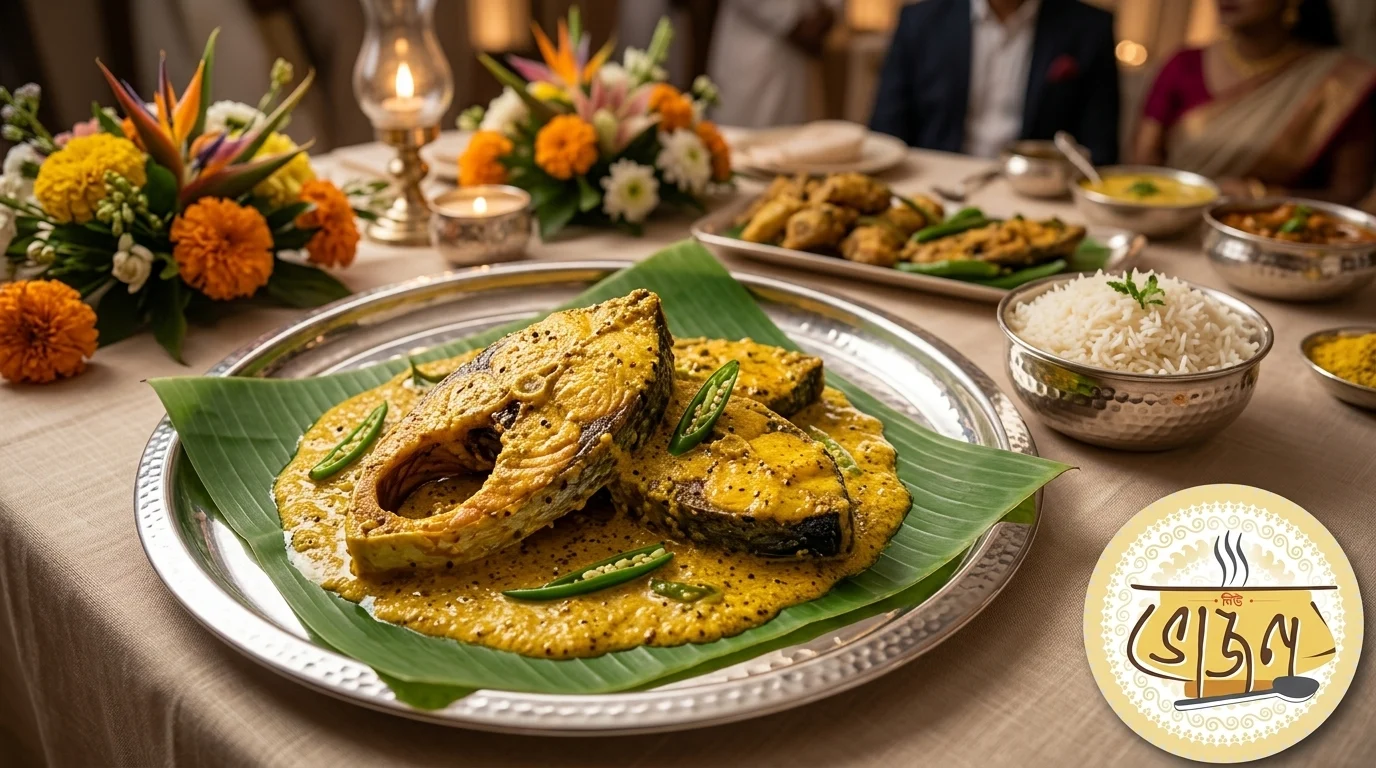
This is the moment the entire menu has been building toward. The fish course is the centrepiece of a biye bari. It's where the caterer's skill is most visible, where the family's generosity is most expressed, and where the guests pay the most attention. Get the fish course right, and the entire meal is remembered fondly. Get it wrong, and nothing else can save it.
- Shorshe Ilish (শর্ষে ইলিশ — Hilsa in mustard) is the king of the biye bari table. Hilsa (ilish) fish — the national fish of Bangladesh and the undisputed star of Bengali cuisine — cooked in a thick mustard paste with green chillies, mustard oil and a touch of turmeric. The mustard sharpness, the fat of the hilsa and the heat of the green chilli create a combination that has no equal in Indian fish cookery. According to Bengali cuisine documentation, ilish is considered the most prized fish in the Bengali-speaking world and holds near-sacred status in wedding contexts. Ilish is a seasonal fish (peak season July–October), and its price fluctuates significantly. In peak season, good quality ilish for a 300-person wedding can cost ₹80,000–₹1,20,000 in ingredient cost alone. Off-season, the price spikes further. This is why the ilish course is the single biggest driver of per-plate premium at a Bengali wedding. Budget menus skip ilish; premium menus feature it prominently.
- Bhetki Paturi (ভেটকি পাতুড়ি) — Bhetki (Barramundi) fish fillets marinated in mustard paste, wrapped in banana leaf and steamed or grilled. The banana leaf imparts its own fragrance during cooking. This is the most visually dramatic fish presentation at a biye bari — guests unwrap their own banana-leaf parcel at the table, which is a wonderful theatre for a sit-down meal.
- Chingri Malai Curry (চিংড়ি মালাই কারি) — Large tiger prawns (golda chingri) in a rich coconut milk and spice gravy. The word "malai" comes from malaya (meaning coconut milk in this context), not cream — though the final dish does have a creamy quality. This is the most popular seafood dish at premium biye bari spreads. For budget events, smaller chingri (choto chingri) in a similar gravy is a substitute, though the eating experience differs.
- Doi Maach (দই মাছ) — Fish cooked in a yoghurt-based gravy. Usually made with rohu (rui) or katla, this is a milder, more aromatic preparation compared to the sharpness of shorshe ilish. It's a good complement on the menu, giving guests a second fish option with a different flavour profile.
- Bhetki Fry / Fish Orly — Crispy fried bhetki, often served with tartar sauce or kasundi at premium events. This is also the fish item that appears in the starter section as "fish fry" — the presentation changes between starter and main course versions, but bhetki is the fish of choice in both.
- Katla Kalia (কাটলা কালিয়া) — A red, spicy fish curry made with rui (Rohu) or katla, cooked with onion, tomato and whole spices. This is the "volume" fish dish — it feeds large guest counts affordably and is almost universally liked. Most mid-range biye bari menus include katla kalia as their core fish dish, with bhetki paturi or shorshe ilish as the premium addition.
Meat Dishes — মাংস
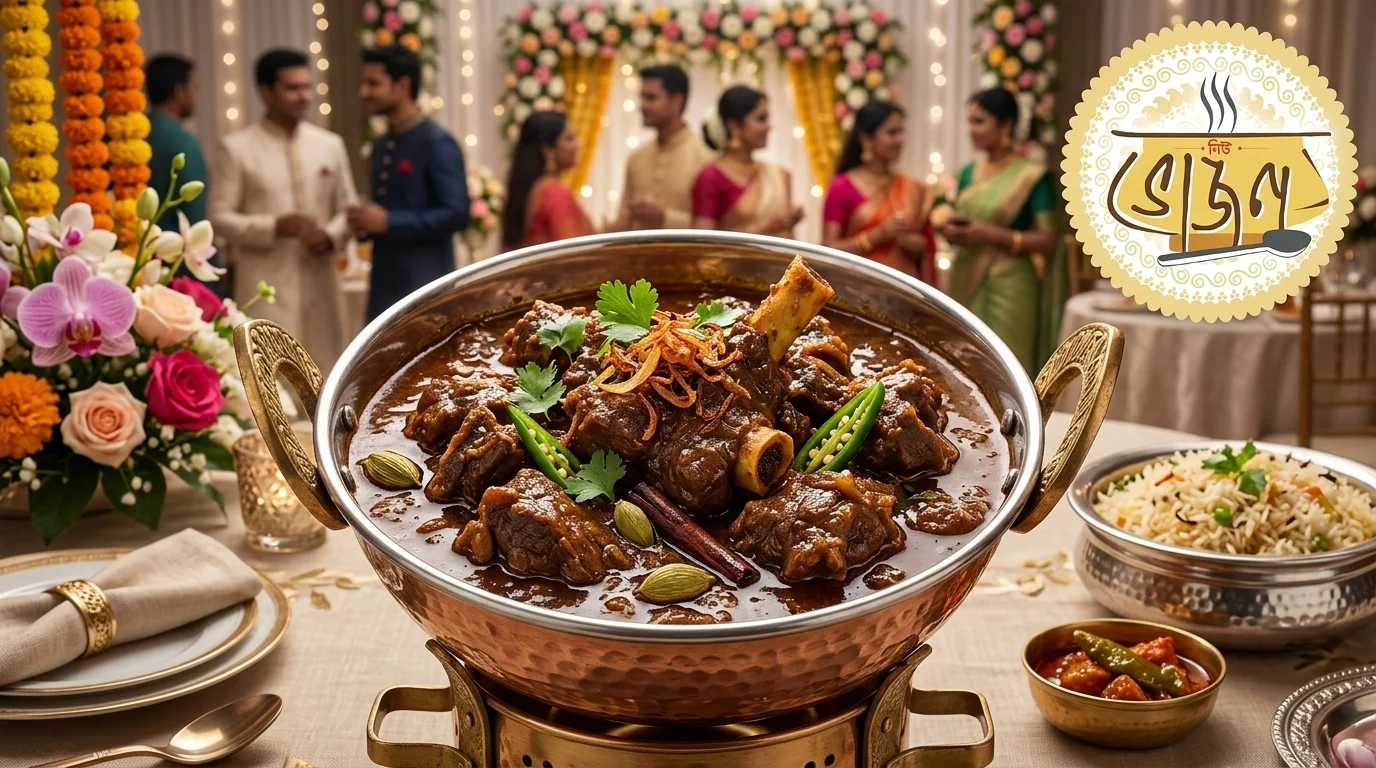
After the fish course comes the meat. At a traditional Bengali biye bari, the meat course is about one dish above all others.
- Kosha Mangsho (কষা মাংস — slow-cooked mutton) is the signature meat dish of Bengali weddings. Mutton pieces cooked low and slow in their own fat with whole spices, onion, ginger, garlic and a heavy hand of black pepper until the gravy is thick, dark and clinging. "Kosha" means "slow-fried" or "reduced" — the technique, not the spice level, is what defines it. Good kosha mangsho takes 2–3 hours of cooking with active stirring. A rushed version is immediately detectable. This is the dish guests talk about after the event — "the kosha mangsho was phenomenal" or "something was off with the kosha mangsho." There's no middle ground.
- Kolkata Biryani (কোলকাতা বিরিয়ানি) — The Kolkata biryani is its own category. Aromatic basmati rice cooked with mutton or chicken, saffron-infused milk, whole spices and — distinctively — whole potatoes and boiled eggs. The potatoes are not an accident. They're a holdover from a time when meat was expensive and potatoes were affordable, but they've become a defining characteristic of the Kolkata style. Most guests expect to find aloo (potato) in their biryani at a Kolkata biye bari.
- Mutton Rezala (মাটন রেজালা) — A Mughlai-influenced white mutton curry made with yoghurt, cream, poppy seed paste and aromatic spices. The colour is pale, the flavour is deep. It's a more elegant, less rustic presentation than kosha mangsho, and pairs beautifully with naan or paratha. Rezala typically appears at premium biye bari events rather than standard spreads.
- Chicken Roast (চিকেন রোস্ট) — Whole or half-chicken roasted in a thick, spiced gravy. This is a party staple, especially popular with younger guests and families who prefer chicken over mutton. Some menus include both chicken and mutton; smaller-budget events often choose one.
- Chicken Kosha or Chicken Kasha — The chicken equivalent of kosha mangsho. Earthy, thick gravy, cooked slow. A strong mid-range option for weddings where mutton is outside the budget.
Desserts & Mishti — মিষ্টি, পায়েস, পান
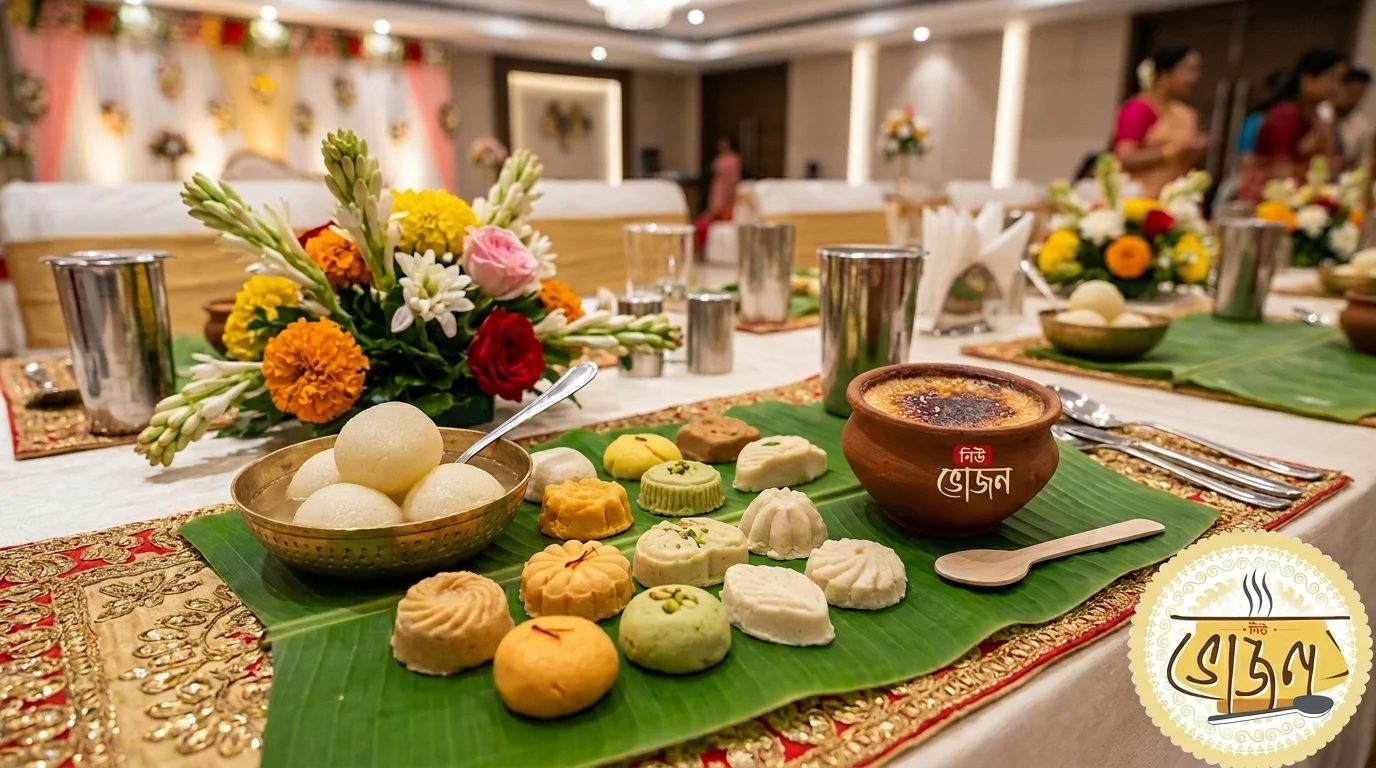
And now we arrive at the heart of Bengali identity. You can argue about any other course, but the mishti section at a biye bari is sacred. It must be good. It must be plentiful. And it must feel Bengali.
- Rosogolla (রসগোল্লা) — Soft chhena (cottage cheese) balls soaked in light sugar syrup. This is the most iconic Bengali sweet and the emotional close of the meal. A good rosogolla should be soft enough to press gently between tongue and palate without any graininess. The syrup should be light, not cloying. Bengali guests know the difference instantly.
- Sandesh (সন্দেশ) — Chhena-based sweets in various shapes, sometimes flavoured with fruit, nolen gur (date palm jaggery) or chocolate for modern events. The texture is firmer than rosogolla, the flavour more delicate. Premium sandesh — especially Nolen Gurer Sandesh in winter — is one of the defining flavours of a high-quality Bengali wedding.
- Mishti Doi (মিষ্টি দই — sweetened yoghurt in clay pot) — Thick, caramel-coloured sweetened yoghurt set in earthen pots. The clay pot is important — it absorbs excess moisture and keeps the doi at the right texture. Mishti doi served in plastic cups or at room temperature is a downgrade that Bengali guests notice immediately. Serve it from clay pots, set properly, at the right cool temperature.
- Payesh (পায়েস — rice pudding) — Gobindobhog rice (or sometimes sabudana / vermicelli) cooked in whole milk with sugar or jaggery and fragrant spices. This is the most traditional of all Bengali sweets — served at almost every auspicious occasion from birth to marriage. The milk is reduced slowly until thick. Nolen gurer payesh (with date palm jaggery) in winter is extraordinary.
- Nolen Gur Specialties (নলেন গুড়) — Date palm jaggery is a winter seasonal ingredient that transforms every sweet it touches. Nolen gurer rosogolla, nolen gurer sandesh, nolen gurer ice cream — these are the most in-demand items at winter weddings (November to February). We've served nolen gur dessert counters at events where guests lined up three deep. It's worth the seasonal premium.
- Chutney & Papad — The transition between savoury and sweet. A Bengali wedding meal always includes tomato chutney or amsatto (raw mango) chutney, served just before the sweets, as a palate cleanser. Papad (crispy lentil wafers) go alongside. It's a small detail, but skipping it breaks the sequence.
- Paan Counter (মুখশুদ্ধি / পান) — The last element of a proper biye bari is the paan station. Banarashi paan with betel leaf, areca nut, lime, fennel and rose petals — prepared fresh at a live counter. Paan is the mukhshuddhi: the literal "mouth cleanser" that closes the meal. A live paan counter runs at every wedding we've catered and it always draws a crowd right at the end of the evening.
Bengali Wedding Menu Pricing in Kolkata 2026
Now let's talk about what all of this costs. The menu above can be delivered across several price tiers. Here's the current market picture for Bengali wedding catering in Kolkata.
Market-wide per-plate pricing (June 2026):
| Tier | What's Included | Per Plate (₹) |
|---|---|---|
| Budget Vegetarian | Luchi/kochuri, chholar dal, 2–3 veg dishes, aloor dum, rosogolla, mishti doi | ₹640 – ₹780 |
| Standard Non-Vegetarian | Basanti pulao, luchi, chholar dal, veg dishes, katla kalia or doi maach, kosha mangsho, rosogolla, mishti doi | ₹800 – ₹1,000 |
| Premium Bengali (with ilish) | Full standard menu + shorshe ilish, chingri malai curry, bhetki paturi, sandesh, payesh, 1 live counter | ₹1,000 – ₹1,300 |
| Royal Bengali / Bonedi Barir | 25–35 dishes, full fish and meat spread with ilish, chingri, kosha mangsho, rezala, full mishti counter, live fuchka + paan | ₹1,500 – ₹2,555 |
These are all-in market ranges. GST (typically 5%) and live counter charges are additional. Always get an itemised quote from your caterer. Prices from New Bhojon Caterer — see our catering cost per plate in Kolkata 2026 guide for detailed per-event calculations.
New Bhojon Caterer's Bengali wedding packages (starting prices):
| Package Name | Style | Per Plate (₹) | Suitable For |
|---|---|---|---|
| Maharani | Bengali vegetarian | ₹777 | Annaprashan, griha pravesh, veg biye |
| Saptapadi | Bengali non-veg standard | ₹897 | Mid-range wedding, 100–500 guests |
| Ashtamangal | Bengali non-veg mid-tier | ₹1,050 | Premium reception, larger events |
| Rajbhog | Bengali + North Indian | ₹1,350 | Multi-cuisine upscale event |
| Bonedi Barir | Full royal Bengali spread | ₹2,555 | Heritage-style, large grand events |
For the complete dish list under each package, visit our Bengali wedding catering services in Kolkata page.
What Affects Your Bengali Wedding Catering Cost
Not all per-plate quotes are comparable. Here are the five factors that move the needle most.
- Ilish (hilsa) vs bhetki vs katla — fish choice is the biggest cost variable. Shorshe ilish for 400 guests can cost ₹80,000–₹1,50,000 in fish alone (depending on season and quality). Bhetki is significantly cheaper but less prestigious. Many families add ilish for close family sitting and bhetki paturi for the general buffet — a practical and cost-effective approach.
- Live counters add ₹80–₹150 per plate each. Each live counter (fuchka, chaat, kebab, paan, dessert, mocktail) adds to the per-plate effective cost. Two live counters on a 400-person wedding adds ₹64,000–₹1,20,000. They're worth it, but price them accurately before committing.
- Guest count below 200 costs more per plate. Fixed costs (kitchen team, supervisor, equipment) don't scale proportionally below 200 guests. The sweet spot for per-plate economy is 250–500 guests. Below 150, expect the per-plate rate to be ₹50–₹100 higher.
- Peak wedding season (November–February) adds 10–15%. Caterers price higher during the Kolkata wedding season. A December wedding at ₹950/plate might be ₹830 in August for the same menu. Book early and lock the price in writing.
- Venue distance and logistics. An event venue in central Kolkata versus Action Area III in Newtown or an outer-ring location will affect the caterer's transport cost. Usually built into the quote, but worth asking about explicitly.
Budget vs Premium Bengali Wedding Menu — Smart Swaps Guide
Every family wants the best food. But not every family has the same budget. Here are five swaps that genuinely preserve authenticity without sacrificing the experience.
- Swap 1: Katla Kalia in place of Shorshe Ilish — save ₹50–₹80 per plate without losing the fish course. Katla (rohu or catla) kalia is a proud, genuinely Bengali dish. It's not a compromise — it's a different preparation. Serve it well and guests will enjoy it. But do include at least one premium fish dish (bhetki paturi is more affordable than ilish) so the fish course doesn't feel thin.
- Swap 2: Chicken Kosha instead of Mutton Kosha — save ₹30–₹50 per plate. Mutton is the traditional choice, but quality chicken kosha made with the right masala base is thoroughly satisfying. This works best for younger guest lists. For events where older guests are the majority, keep the mutton.
- Swap 3: One live counter instead of three — save ₹120–₹300 per plate. A live fuchka counter is the one you must keep. Chaat and kebab counters are bonus. Skip the pasta station and the dessert counter at the starter stage if budget is tight — save those for an upgrade if you need to trim.
- Swap 4: Kochuri for some guests, luchi for others — manage kitchen output more efficiently. Both are beloved. Mixing them rather than serving only luchi (which requires constant frying) reduces kitchen stress and ensures guests always get something hot. This is a logistics swap, not a quality compromise.
- Swap 5: Seasonal mishti over premium branded sweets — same quality, lower cost. Nolen gur is only available October–February but costs less per unit than premium fusion sweets at any time of year. A November wedding with nolen gur rosogolla and sandesh is actually more authentic and more affordable than a June wedding trying to replicate the same with off-season ingredients. Time your menu to the season.
For a deeper look at how Bengali catering has evolved over generations, read our piece on Bengali catering traditions and modern fusion.
How to Plan the Biye Bari Menu — Practical Steps
Knowing what to serve is one thing. Putting it all together is another. Here's how we recommend approaching the menu planning process.
- Start with your guest count and the event type. Is this a wedding reception (biye / biyer saath) or a bou-bhat? A holud function or an engagement? The meal structure differs. A bou-bhat is typically a heavier lunch or dinner; a holud is lighter and more casual.
- Decide on veg vs non-veg ratio early. If 20% of your guests are strictly vegetarian, your caterer needs to plan two parallel tracks — not just remove the fish from one plate. Good caterers manage this silently and efficiently; ask specifically how they handle it.
- Set a realistic per-plate budget before calling anyone. Know your total catering budget and divide by expected guest count. That gives you a working per-plate figure. Then add 10–15% buffer for GST, transport and small upgrades you'll inevitably want.
- Tasting is not optional for events above 200 guests. Every caterer we'd recommend will offer a tasting. Take it. Focus on the chholar dal, the ilish (or whatever fish dish you're serving), and the kosha mangsho. If those three taste right, the rest usually follows. For guidance on evaluating caterers, our how to choose the best caterer checklist covers every question worth asking.
- Think about the live counter placement in your venue. A fuchka counter near the entrance works well as guests arrive and wait. A paan counter at the exit creates a memorable close. Don't place both in the same corner — spread them out to manage crowd density.
Thinking about going fully vegetarian? Our vegetarian catering guide for Kolkata covers a complete veg biye bari menu in detail.
Frequently Asked Questions
What food is served at a Bengali wedding?
What is the traditional Bengali wedding menu?
What fish dishes are served at Bengali weddings?
What is Bengali wedding catering cost per plate?
What is a live counter at a Bengali wedding?
What are the popular desserts at a Bengali wedding?
Can we have a vegetarian Bengali wedding menu?
What is the difference between a biye bari menu and a bou-bhat menu?
Is Kolkata biryani served at Bengali weddings?
What is the difference between shorshe ilish and bhetki paturi?
How far in advance should I finalise the Bengali wedding menu?
Does a Bengali wedding have to include ilish?
What is nolen gur and why do people want it at weddings?
Plan Your Bengali Biye Bari with New Bhojon
Twenty years of biye bari catering in Kolkata has taught us one thing above everything else: the families who remember their wedding food the most are the ones who didn't compromise on three things — the fish, the kosha mangsho and the mishti doi. Everything else is adjustable.
We're here to help you plan a biye bari that your guests will talk about. New Bhojon Caterer offers 15 packages from ₹777 to ₹2,555/plate, with full Bengali menus, transparent pricing and an FSSAI-certified kitchen that's been running since 2006.
| Call | +91 9231806210 / +91 9831165165 |
|---|---|
| +91 9231806210 | |
| info@newbhojon.com | |
| Address | 70A Surya Sen Street, College Square, Kolkata 700009 |
| Google Maps | Find Us Here |
| Certifications | FSSAI 12820019000862 · KMC Trade Licence C.E. No. 007551034206 · GST 19AOQPD3904E1Z1 |
Also find us on Facebook · Instagram · YouTube
Want more resources? Browse all catering guides on our blog, read our live counter catering ideas guide, or explore our Bengali wedding catering services page for package details.
All pricing in this guide is current as of June 2026. Menu items and ingredient availability may vary by season. Confirm your final menu and pricing in writing with New Bhojon Caterer at the time of booking.