Table of Contents
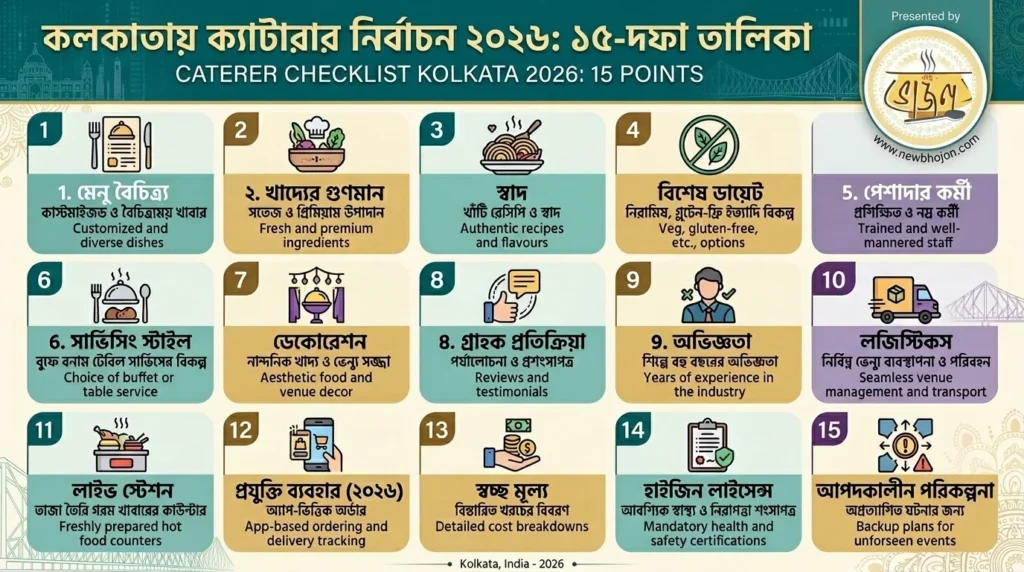
Quick Answer — 15 things to check before hiring a caterer in Kolkata: (1) FSSAI food-safety licence, (2) KMC trade licence / CE number, (3) GST-inclusive written quote, (4) menu tasting session, (5) per-plate price in writing, (6) Bengali cuisine depth, (7) service area and logistics plan, (8) Google review text quality, (9) staff ratio and uniforms, (10) crockery and equipment inclusions, (11) last-minute change policy, (12) waste handling, (13) event-type specific experience, (14) reference from a recent same-type event, (15) full written contract.
The moment you start looking for a caterer in Kolkata, you'll get inundated with calls. Everyone claims to be the "best." Everyone says they have 20 years of experience. Everyone's pricing sounds reasonable until the final bill arrives with surprises.
We've been catering events in Kolkata since 2006. In 20 years, we've seen families get burned by vague quotes, unlicensed kitchens and caterers who simply didn't know how to cook a proper kosha mangsho. We've also seen families who did their homework — asked the right questions, got everything in writing, and walked away from their events with nothing but compliments from guests.
The difference between those two groups almost always comes down to preparation. So this checklist exists to give you the preparation you need. It's Kolkata-specific — covering FSSAI licences, KMC trade registration, GST brackets, Bengali menu criteria and the logistical realities of this city's geography. Nothing in this list is generic.
Work through all 15 points before signing anything. Your guests will thank you.
Why Choosing the Right Caterer Matters in Kolkata
Food is the most remembered thing about any event. Not the decoration. Not the music. Food. Research consistently shows that over 70% of wedding guests say food is the aspect of an event they remember most — and talk about most afterward. Get the catering right, and guests associate that warmth with you and your family for years.
Get it wrong — cold fish fry, overcooked kosha mangsho, mishti doi that wasn't set — and that's what they'll talk about instead.
Kolkata has its own specific catering culture. A biye bari (Bengali wedding) has precise expectations around dish sequence, fish quality and mishti variety. A corporate event in Sector V needs a different speed and format entirely. An annaprashan at a Rashbehari community hall has different setup logistics than a banquet reception in Newtown. The caterer you choose needs to understand all of this — not just know how to cook.
And then there are the purely practical compliance issues. FSSAI licences, KMC trade registrations, GST invoicing — these aren't bureaucratic formalities. They're signals that the caterer runs a professionally managed operation. When things go wrong (and sometimes they do), a licensed, documented caterer gives you legal recourse. An unlicensed one does not.
Use every point in this checklist. It takes 45 minutes to go through properly. That's a small investment for an event that matters.
15-Point Checklist: How to Choose a Caterer in Kolkata
1. Verify the FSSAI Food-Safety Licence
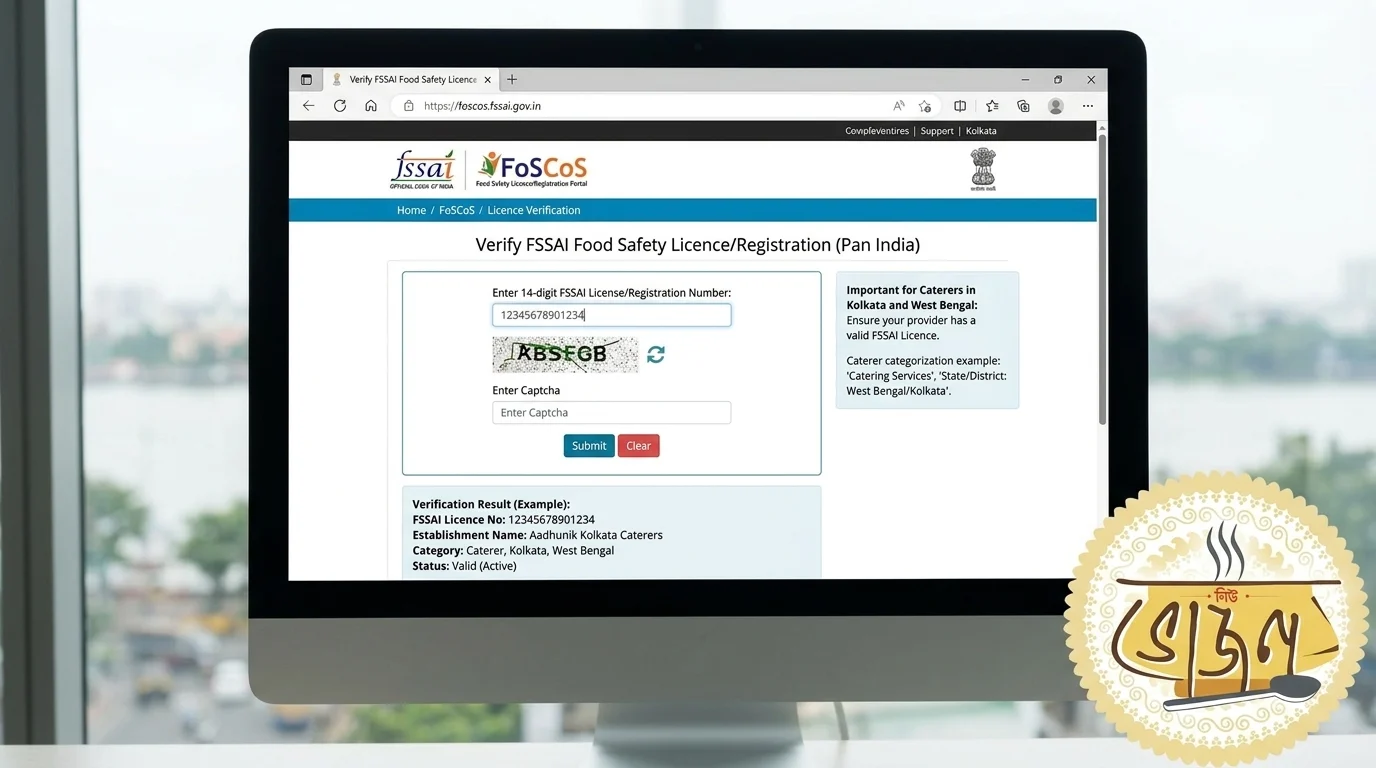
This is the non-negotiable first check. Every catering business operating in India must hold a valid FSSAI (Food Safety and Standards Authority of India) licence. This isn't a nice-to-have — it's a legal requirement under the Food Safety and Standards Act, 2006.
How to verify: Go to foscos.fssai.gov.in, click 'Search Licence / Registration' and enter the caterer's licence number. The result shows the business name, address, licence type and validity date. This takes under 30 seconds. If the caterer can't give you a number to check — move on.
What FSSAI licence types mean: Basic Registration covers businesses with turnover up to ₹12 lakh. State Licence covers turnover from ₹12 lakh to ₹20 crore. Central Licence applies to larger operations. For a caterer serving 300-guest weddings regularly, a State Licence is the minimum appropriate level.
What to ask: "Can you share your FSSAI licence number so I can verify it?" A legitimate caterer gives you this immediately. New Bhojon's FSSAI licence is 12820019000862 — verify it yourself.
Under the 2026 FSSAI amendments, penalties for operating without a licence can reach ₹5 lakh plus imprisonment under §55. That's how seriously Indian law treats food safety compliance. Don't skip this check.
2. Check the KMC / Municipal Trade Licence
Kolkata-specific, and often overlooked. The Kolkata Municipal Corporation requires every business operating within its jurisdiction to hold a valid Certificate of Enlistment — their trade licence — under Section 199 of the KMC Act 1980. The licence is identified by a "C.E. No." (Certificate of Enlistment number).
Why this matters: A valid KMC trade licence confirms the business is registered at the stated address, pays its municipal fees and operates legally within the city. It's verifiable at the KMC portal (kmcgov.in). An unlicensed caterer may have no fixed business premises — which creates genuine risks around accountability if something goes wrong.
What to ask: "Do you have a KMC trade licence? Can you share the C.E. number?" If the caterer covers areas outside Kolkata Municipal Corporation limits (Bidhannagar, Newtown, Rajarhat), they may hold a KMC licence for their base kitchen and a separate municipal registration for service areas. Ask about both.
New Bhojon's KMC Trade Licence number is C.E. No. 007551034206.
Don't be embarrassed to ask this. Legitimate businesses expect compliance questions from serious clients.
3. Ask for a GST-Inclusive Quote — and Understand the Rate
The most common billing surprise in Kolkata catering is GST — Goods and Services Tax — being added at the end of an event to a quote that only covered food cost.
How GST on catering works in 2026:
- 5% GST (without Input Tax Credit) applies to standalone outdoor event catering, office canteen supplies and most independent caterers serving weddings and private functions.
- 18% GST (with Input Tax Credit) applies when catering is bundled with banquet hall services at a hotel, or when the caterer is a registered business choosing the ITC route.
The practical impact: on a ₹900/plate quote for 300 guests (₹2,70,000 food cost), 5% GST adds ₹13,500 to the bill. 18% adds ₹48,600. That's a significant difference — and many families only discover it at the final invoice stage.
What to ask: "Is GST included in your per-plate quote? At what rate? Can you provide a pro-forma invoice showing the full amount including GST?" You should receive a GST-registered invoice with the caterer's GSTIN (GST Identification Number).
New Bhojon's GST registration is 19AOQPD3904E1Z1. We always clarify our GST position at the quotation stage and show it separately on all invoices.
4. Taste Before You Book
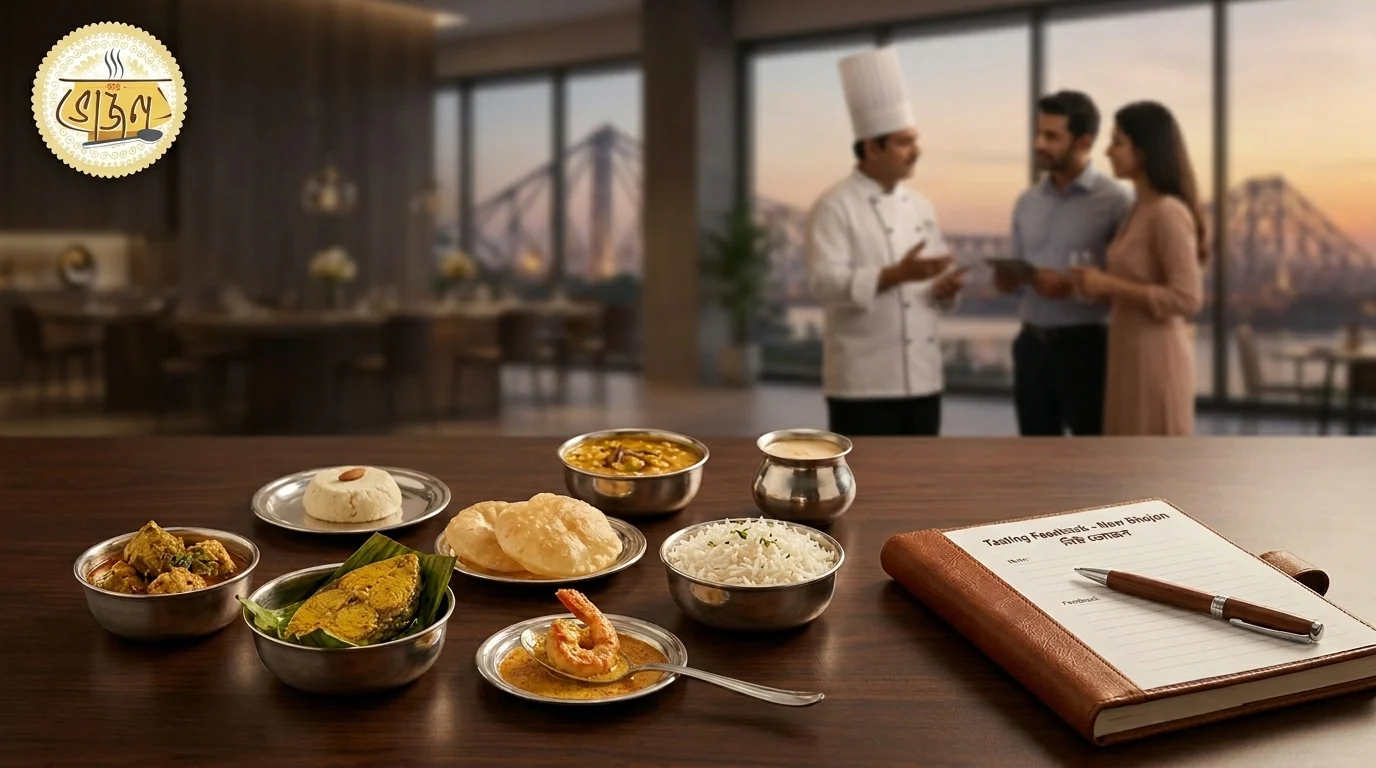
This should be mandatory for any event above 150 guests. A tasting session lets you evaluate the actual food — not samples from a portfolio, not photos, not promises. The real thing.
What to focus on at the tasting:
The chholar dal is a reliable indicator of a Bengali caterer's skill level. It should taste thick, slightly sweet, with coconut pieces and proper tempering. A thin or bland chholar dal usually means shortcuts elsewhere too. Similarly, taste the kosha mangsho. The gravy should be deeply reduced and fragrant — if it's watery or spice-forward without depth, the slow cooking hasn't happened properly.
For non-Bengali events, focus on whatever your main course items are. If they're promising North Indian, taste the dal makhani. If Chinese, taste the fried rice — not the Manchurian (which is easy), the rice (which shows technique and ingredient quality).
What tasting etiquette looks like in Kolkata: Most reputable caterers offer a tasting at their kitchen or at a neutral location for bookings above 200 guests. Some charge a small fee for the tasting (₹500–₹2,000 per head), refunded on booking. If a caterer refuses to offer a tasting at all, treat that as a significant red flag.
Bring 2–3 family members who have genuine food opinions. Take notes. Don't sign anything at the tasting itself — the objective is evaluation, not commitment.
5. Confirm Per-Plate Price Fully — in Writing
"Per-plate" quotes mean different things to different caterers. Always clarify exactly what's inside the number before comparing quotes.
What a per-plate quote should include:
- Defined dish list for the confirmed menu
- Service staff count at the promised ratio
- Basic chafing dishes and buffet equipment
- Crockery type (specify whether stainless, disposable or ceramic)
- Transport to venue (included or separate)
What's often excluded:
- Live counter charges (fuchka, paan, kebab stalls)
- Premium crockery rental
- Extended service hours beyond the contracted window
- Transport if the venue is outside the caterer's regular zone
- GST (as covered in point 3)
A per-plate quote of ₹850 with two live counters, transport to Newtown and GST could realistically land at ₹1,050–₹1,100 per plate all-in. Know this before you compare caterers.
What to ask: "Can you provide a full itemised pro-forma invoice showing everything included and everything extra at this per-plate rate?" Caterers who have nothing to hide will do this without hesitation.
For reference, see our full catering rate card with all package inclusions — this is the level of transparency you should expect from any caterer.
6. Check Bengali Cuisine Depth — with Specific Tests
If you're planning a Bengali event in Kolkata — a biye bari, an annaprashan, a bou-bhat — then Bengali cuisine depth is non-negotiable. And you can test it with specific questions rather than taking the caterer's word for it.
The three Bengali cuisine tests:
Test 1 — Fish: Ask which fish dishes they can provide and how they source the ilish (hilsa). Can they get fresh Padma ilish or Rupnarayan ilish for the wedding season? How far ahead do they order to guarantee fresh fish vs frozen? A genuine Bengali specialist has a fish supplier relationship, not just a frozen stock.
Test 2 — Kosha Mangsho: Ask how long they slow-cook their kosha mangsho. The authentic answer is 2–2.5 hours minimum, with active stirring. If they say "45 minutes" or give a vague answer, the quality will show on the plate.
Test 3 — Mishti: Ask what mishti options they provide and whether they can include nolen gur (date palm jaggery) sweets for winter events. A Bengali caterer worth booking can source nolen gur from specific mishti suppliers in season, and knows exactly which items are seasonal.
For the complete Bengali wedding menu guide — what each course should contain and in what order — visit our Bengali wedding menu guide 2026.
7. Verify Service Area and Logistics Plan
A caterer who normally serves South Kolkata will approach a Newtown event in Action Area III very differently from one who does regular runs on the EM Bypass corridor. And the difference shows up on event day.
Questions to ask:
- How far is your base kitchen from my venue?
- What route do you use and how long does transport take? (Verify this — don't just take the optimistic answer.)
- Have you catered at this specific venue before? Any load-in restrictions, vendor pass requirements or equipment constraints?
- For cross-river venues (Howrah), how do you manage bridge traffic on event days?
- For outer zone venues (Barrackpore, Rajarhat border areas), is there an additional transport charge?
A caterer who gives vague or overconfident answers to venue logistics questions is one you'll be following up with anxiously on the event day itself. The caterer who gives you specific, detailed answers — including honest travel time estimates based on actual experience — is the one worth trusting.
8. Read the Text of Google and WedMeGood Reviews — Not Just the Stars
A 4.8-star rating is easy to achieve with 15 friends and family members leaving five stars each. What you can't fake is the text of a review that describes the kosha mangsho specifically, or mentions that the staff replenished the fish counter twice during the event, or notes that the caterer was the first vendor to arrive and the last to leave cleanup.
What to look for in review text:
- Event-specific detail — the dish, the venue, the guest count
- References to punctuality and logistics ("food arrived hot despite the venue being far")
- Mention of specific staff behaviour ("the counter chef at the fuchka station was excellent")
- How the caterer handled a problem if one arose ("one dish ran out and they managed it quickly")
Where to check:
- Google Business Profile (most reliable — harder to game)
- WedMeGood (wedding-specific reviews)
- WeddingWire India
- Facebook page reviews
Red flags in reviews: Generic praise ("great food and service!"), very short text, a sudden cluster of reviews within a short time window, and no mention of specific events or dishes. These patterns can indicate manufactured reviews.
See why New Bhojon consistently earns specific, event-detailed reviews in our top caterers Kolkata overview.
9. Ask About Staff Ratio, Training and Uniforms
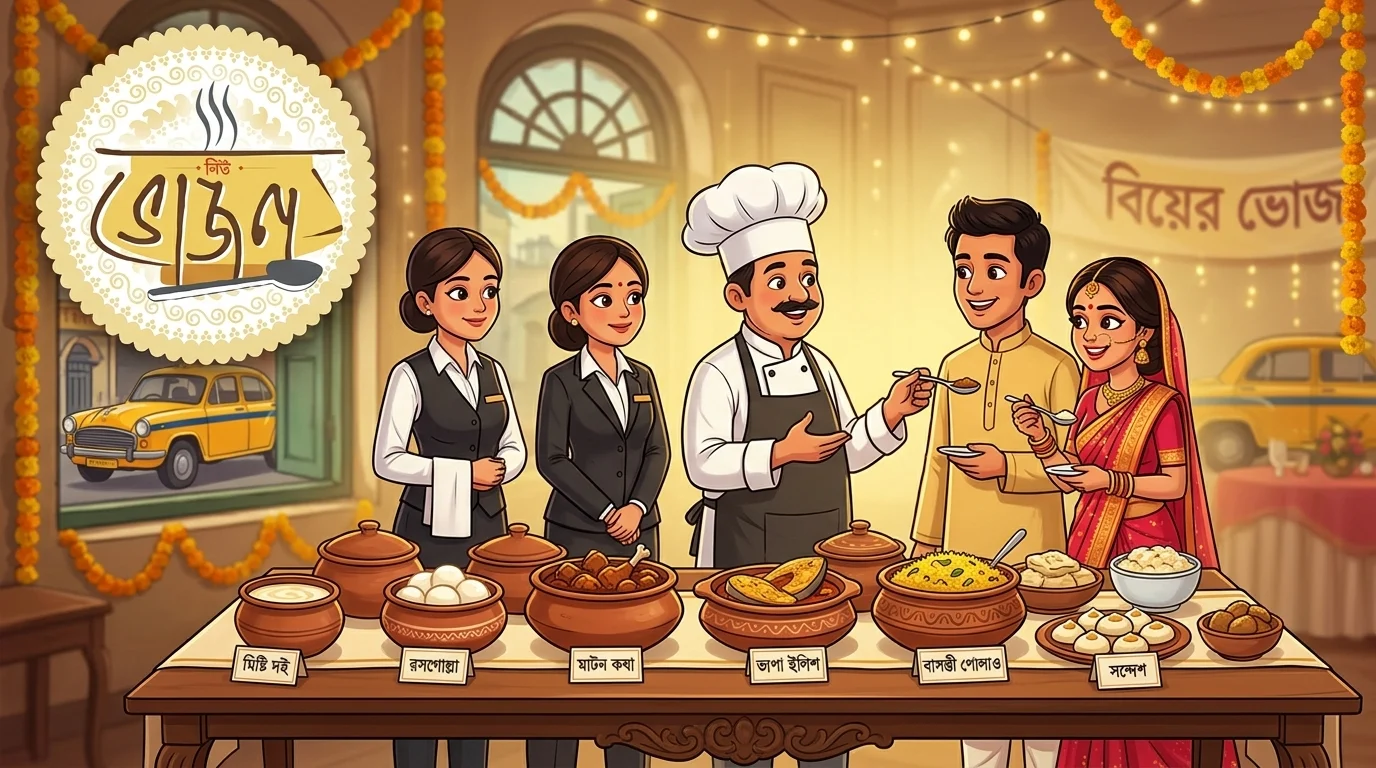
The food can be brilliant. But if the service team is understaffed, guests wait at the buffet, dishes run empty, and the event feels chaotic. The staff are your caterer's face at the event — and guests judge the catering by how they're served, not just what they eat.
Standard staff ratio:
- Buffet service: 1 trained server per 25–30 guests
- Formal sit-down (paat-pere biye): 1 server per 15–20 guests
- Live counter: 1 dedicated counter chef per station
For a 300-guest wedding buffet, that means 12–15 servers plus a separate kitchen team and an on-site supervisor. Ask specifically for the staff breakdown, not just "we'll have enough people."
What to look for:
- Uniformed staff (dedicated catering uniform, not the kitchen team's cooking clothes)
- Designated on-site supervisor who doesn't also cook or serve — this person manages issues as they arise
- Clear briefing process: do staff know the menu, the venue layout, the event timeline?
- Language: for events in South Kolkata or Bengali-family events, do staff communicate comfortably in Bengali?
What to ask: "How many service staff do you send for [your guest count]? Do they wear uniforms? Who is the on-site supervisor, and will they stay for the full event duration?"
10. Confirm Crockery, Equipment and Setup Inclusions
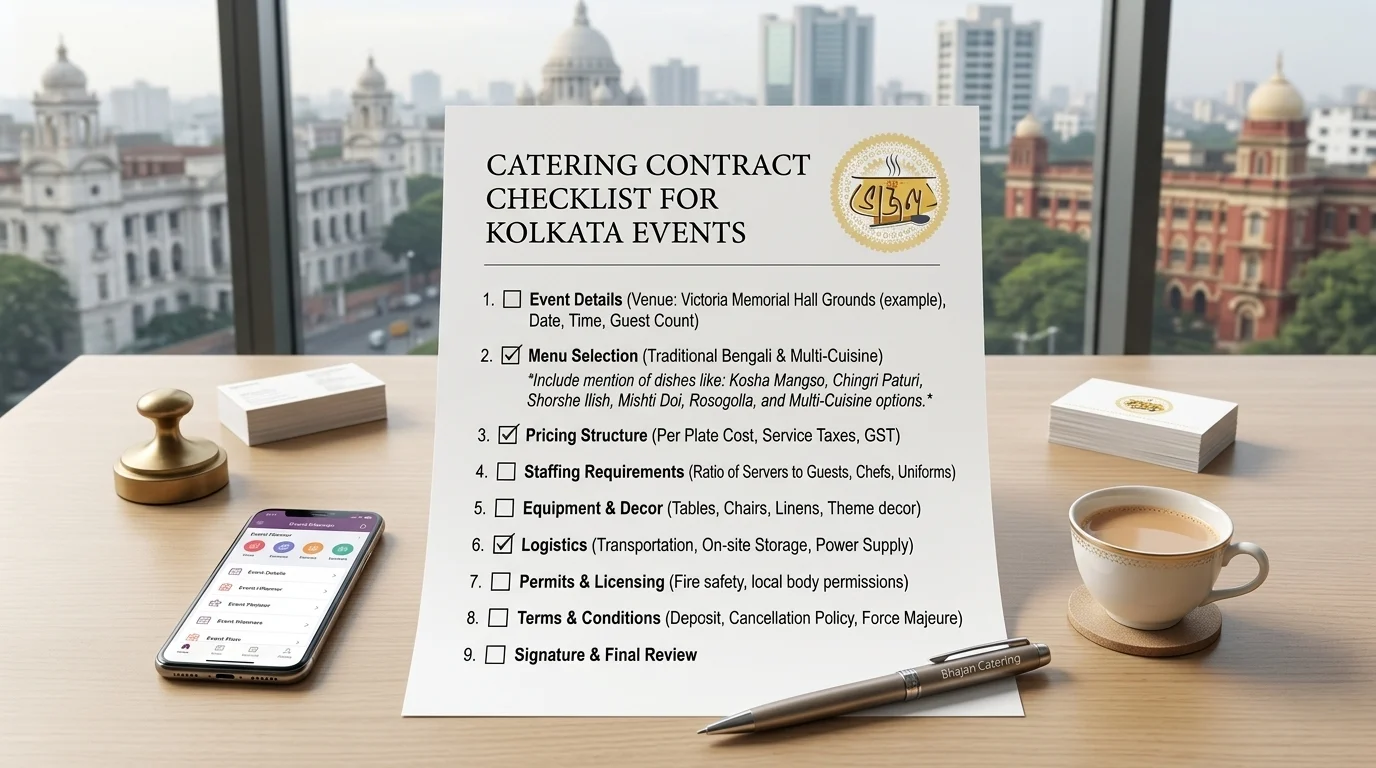
"Full service catering" means different things to different caterers. Some include everything from chafing dishes to linen napkins. Others define "full service" as food plus one server. Know exactly what you're getting.
Standard equipment a caterer should provide:
- Chafing dishes (bain-marie style food warmers) for all hot dishes
- Serving ladles, tongs and spoons for each item
- Serving trays for starter rounds
- Insulated transport containers for kitchen-to-venue food transport
Items that are often extra:
- Tables and chairs (typically the venue's responsibility, but sometimes caterers supply)
- Tablecloths and linen
- Candles and centrepieces
- Ice for cold counters
- Premium ceramic or silver crockery (usually an upgrade from standard stainless)
- Generator or power backup (for outdoor events — critical in Kolkata summer)
Ask for an itemised equipment list as part of your written quote. A caterer who can't produce this list hasn't thought through the logistics of your event yet.
11. Clarify the Last-Minute Change Policy
Guest counts change. Always. A function planned for 250 guests will often settle at 220 or jump to 280 on the day. How your caterer handles this reveals a lot about how professionally they operate.
What to ask:
- What's the final guest count deadline? When is the last point I can increase or decrease the number?
- What happens if actual attendance is 10% above the contracted count? Is there a penalty or can you accommodate?
- If I need to add a dish or remove one after the menu is confirmed, how is that handled?
- What's your cancellation policy, and how much of the deposit is refundable at different stages?
Standard reasonable terms:
- Final count confirmation: 5–7 days before the event
- 10% variance (up or down) from contracted count: usually accommodated at the same per-plate rate
- Cancellations within 15 days: typically 50% of deposit retained; within 48 hours: full deposit retained
Get these terms in writing. A caterer who can't give you clear answers on cancellation is one who has no policy — which means disputes get resolved informally, and not always in your favour.
12. Ask About Waste Handling and Leftover Policy
This one feels minor until you're at a 400-person event at 11 PM with a kitchen full of leftover food and no plan for it. Responsible caterers have a clear policy — and increasingly, it's something guests and event organisers care about.
Questions to ask:
- What happens to leftover food? Do you donate to an NGO or charity? Take it back? Or leave it to the venue?
- How is food waste disposed of? Who is responsible for clearing the catering area?
- Do you use eco-friendly disposables if the event requires them?
- Who cleans the kitchen area after the event — your team or the venue staff?
Why this matters practically: Many Kolkata banquet halls hold the caterer responsible for post-event kitchen cleanliness. If your caterer doesn't have a cleanup crew, you may find a mess the next morning — and a complaint from the venue manager that falls on you.
New Bhojon's practice: our kitchen team cleans the catering service area before leaving. For large events, we coordinate leftover food donation with NGO partners upon prior arrangement with the client.
13. Check They Handle Your Specific Event Type
A caterer who's brilliant at 500-guest wedding receptions may be completely wrong for a 60-guest corporate lunch. The skills, format, timing and setup requirements are entirely different.
Event-type specific things to confirm:
- Wedding / biye bari: Can they handle the full course sequence? Do they know when to serve chutney relative to the fish course? Can they manage both a live fuchka counter and a paan counter simultaneously?
- Corporate lunch / seminar: Can they serve within a tight time window (60–90 minutes)? Do they provide labelled veg/non-veg separation for corporate clients? Can they handle a standing buffet format efficiently?
- Annaprashan (rice ceremony): Do they have experience with the specific traditional menu — payesh, panta bhat, ilish, sweets in the right sequence? See our annaprashan catering guide for the full traditional format.
- Outdoor / marquee events: Do they have their own power supply solution? How do they manage food temperature in Kolkata summer heat?
- Puja catering: Are they set up for the strict vegetarian satvik menu required for certain pujas?
What to ask: "How many events of exactly this type — same event, similar guest count — have you catered in the last 12 months? Can you walk me through how you typically handle [specific challenge for your event type]?"
14. Ask for a Reference from a Recent, Same-Type Event
Testimonials on a caterer's website are curated. Google reviews are better. But a direct conversation with a past client who ran the same type of event, at a similar venue, in a similar area — that's the gold standard of caterer evaluation.
How to ask: "Can you give me contact details for a client who had a similar event to mine in the last 6 months — similar guest count, similar menu, similar venue type? I'd like to call them." A confident caterer with a strong track record will say yes immediately. One who stalls or deflects is telling you something.
What to ask the reference:
- Did the caterer arrive on time for setup?
- Was the food hot and at the right quality throughout service?
- Were there any issues, and if so, how did the caterer handle them?
- Was the final bill consistent with the original quote, or were there surprises?
- Would you book them again?
That last question — "would you book them again?" — is the most honest answer to how the event actually went.
15. Get All Terms in a Written Contract
Nothing spoken. Nothing assumed. Everything in writing before the booking deposit is paid.
What every catering contract for a Kolkata event must include:
| Item | Why it must be in writing |
|---|---|
| Event date, time and venue address | Prevents date-mix errors (common with busy caterers in peak season) |
| Exact menu — dish names, not categories | "Fish dish" can mean anything; "shorshe ilish + bhetki paturi" is specific |
| Per-plate price with GST clearly stated | Eliminates billing disputes |
| Service staff count and ratio | Holds the caterer to their staff commitment |
| Equipment inclusions | Prevents "we assumed the venue had chafing dishes" surprises |
| Final guest count deadline | When is the last confirmed number required? |
| Payment schedule | Deposit amount, when balance is due, acceptable payment methods |
| Cancellation and rescheduling terms | What you lose if you cancel, what the caterer compensates if they fail |
| Overtime clause | What happens if the event runs 2 hours over the contracted window |
| FSSAI, KMC and GSTIN numbers of the caterer | Creates a legally documented record of the licensed operator |
Do not sign anything that lacks menu specifics or cancellation terms. These are the two most common sources of disputes between clients and caterers in Kolkata.
Our wedding caterers in Kolkata page shows the kind of clarity we provide at the quotation stage. Use it as a benchmark for what to expect.
Questions to Ask at the Tasting Session
A tasting session is where most people under-prepare. They eat, they enjoy (or don't), and they leave without the structured feedback they came for. Here are 10 specific questions to ask during any Kolkata caterer tasting.
Q1. Which fish do you use for the shorshe ilish — Padma, Rupnarayan or river-farmed?
The answer reveals both sourcing knowledge and pricing reality. Padma ilish is the most prized (and most expensive); river-farmed is the budget option.
Q2. How long was this kosha mangsho cooked?
The answer should be 1.5–2.5 hours. Anything less and the gravy won't have developed properly.
Q3. Where does this chholar dal's coconut come from — fresh or packaged?
Fresh coconut pieces in chholar dal taste completely different from packaged. Most quality caterers use fresh.
Q4. Can you replicate this exact dish quality consistently at 300-guest scale?
Many caterers deliver excellent tasting portions but struggle to maintain quality at event scale. Ask this directly.
Q5. Are the dishes I'm tasting the same as what I'd get on the event day?
A caterer should confirm this — or be transparent if the tasting is from a special kitchen batch and explain why.
Q6. What does the tasting sample not include that would be on my event menu?
There may be dishes not ready to taste (the desserts, certain live counter items). Know what you haven't evaluated yet.
Q7. How do you keep fish dishes hot during transport and through 2 hours of service?
This is a critical operational question. Fish served lukewarm is a catering failure.
Q8. What spice level is this, and can you adjust for an older guest demographic?
Many South Kolkata families prefer lighter spicing. A good caterer can adjust by event.
Q9. Is the mishti doi made in-house or sourced from a mishti shop?
Many caterers source mishti from an external shop — that's fine, but you should know which shop and taste it from that source specifically.
Q10. Can I bring a family elder at the next tasting stage for their opinion?
A confident caterer will welcome this. Older family members often have the most calibrated Bengali food opinions.
Frequently Asked Questions
How do I choose the best caterer in Kolkata?
Check these 15 things: FSSAI licence (verify at foscos.fssai.gov.in), KMC trade licence, GST-inclusive written quote, tasting session, per-plate price in writing, Bengali cuisine depth, service area logistics, review text quality (not just stars), staff ratio and uniforms, crockery inclusions, last-minute change policy, waste handling, event-type experience, client reference, and a full written contract.
Is an FSSAI licence required for caterers in India?
Yes — all catering businesses in India must hold a valid FSSAI licence under the Food Safety and Standards Act, 2006. For Kolkata caterers, verify any licence number at foscos.fssai.gov.in in under 30 seconds. Operating without a licence carries penalties up to ₹5 lakh. New Bhojon's FSSAI licence is 12820019000862 — verify it directly.
What documents should I check before hiring a caterer in Kolkata?
Check: FSSAI food-safety licence number (verify at FoSCoS portal), KMC Certificate of Enlistment (C.E. number for Kolkata-based caterers), GST registration number (GSTIN), and written proof of past event references. Ask for a pro-forma invoice showing all charges including GST before signing the booking contract.
How many staff does a caterer provide for 200 guests?
A professional caterer provides at minimum 1 trained server per 25–30 guests for buffet service — so 7–8 servers for 200 guests, plus a kitchen team and a separate on-site supervisor. For formal sit-down or paat-pere service, the ratio increases to 1 per 15–20 guests. Always ask for the specific staff breakdown before booking.
Do caterers in Kolkata provide tables, chairs and crockery?
Crockery and chafing dishes are usually included in catering packages. Tables and chairs are typically the venue's responsibility — but always confirm in writing. Linen, candles and centrepieces are usually extra. Some premium caterers include linen and full table setups as part of higher-tier packages. Ask for an itemised equipment list at the quotation stage.
How far in advance should I book a caterer for a wedding in Kolkata?
Book 6–8 weeks ahead for general weddings. For peak season (October to February), book 10–12 weeks minimum — top caterers in Kolkata fill their peak-season dates by September. For corporate events and birthday parties, 2–4 weeks is usually sufficient. For very large events above 500 guests at specific venues, book as soon as the date and venue are confirmed.
What is the standard GST rate for catering services in Kolkata?
Most independent caterers serving private events, weddings and outdoor functions charge 5% GST without Input Tax Credit. Caterers operating through hotels or banquet hall venues as composite supply typically charge 18% GST with ITC. Always ask your caterer which rate applies to your booking and confirm it on the written pro-forma invoice. The difference on a ₹3 lakh food bill is ₹15,000 vs ₹54,000 in tax.
What is a KMC trade licence and why does it matter for caterers?
The KMC (Kolkata Municipal Corporation) Certificate of Enlistment (identified by a C.E. number) is required under Section 199 of the KMC Act 1980 for all businesses operating within Kolkata Municipal Corporation limits. For a caterer, it confirms they have a legitimate, registered business address within KMC jurisdiction. It's verifiable at kmcgov.in and signals that the caterer runs a professionally registered operation.
How do I know if a caterer's reviews are genuine on Google?
Look at the text, not just the stars. Genuine reviews are event-specific — they mention dishes, venues, guest counts or specific moments. Red flags for fake reviews: very short text, generic praise ("great service!"), a cluster of 5-star reviews within a short time window, and no event detail whatsoever. Cross-check reviews across Google, WedMeGood and WeddingWire. Consistent event-specific praise across multiple platforms is the strongest signal of authentic quality.
Should I do a menu tasting before booking a caterer in Kolkata?
Yes — for any event above 100 guests. A tasting lets you evaluate actual food quality, not promises. Focus specifically on the chholar dal (indicator of Bengali technique), the kosha mangsho (indicator of slow-cooking discipline) and the main fish dish. Bring 2–3 family members with genuine food opinions. Don't commit at the tasting itself — use it purely for evaluation.
What should a catering contract in Kolkata include?
The contract must specify: event date and venue address, exact dish list (not just categories), per-plate price with GST stated separately, service staff count, equipment inclusions, final guest count deadline, payment schedule with dates and amounts, cancellation and rescheduling terms, overtime clause and the caterer's FSSAI and GSTIN numbers. Don't sign anything that lacks menu specifics or cancellation terms.
How do I choose a caterer for a Bengali annaprashan vs a wedding?
An annaprashan has a specific traditional menu sequence (payesh first, then ilish, followed by a vegetarian spread) and often a smaller, more intimate guest count. Not every wedding caterer understands this format. For an annaprashan, ask specifically about their experience with the traditional sequence and verify they know the difference between the puja food and the reception food. Our annaprashan catering guide covers the full traditional format.
Download the Free Kolkata Caterer Checklist
WhatsApp us at +91 9231806210 with the message "Checklist" and we'll send you this full 15-point checklist as a printable PDF — along with our current menu packages and pricing. It's free, it has no strings attached, and you can take it into any caterer meeting you have.
If you're evaluating New Bhojon as one of your options, we welcome the comparison. Every point on this checklist is something we can answer clearly and document. That's the kind of caterer you want for your event.
| Contact | Details |
|---|---|
| Call | +91 9231806210 / +91 9831165165 |
| +91 9231806210 | |
| info@newbhojon.com | |
| Address | 70A Surya Sen Street, College Square, Kolkata 700009 |
| Google Maps | Find Us Here |
| FSSAI | 12820019000862 · KMC: C.E. No. 007551034206 · GST: 19AOQPD3904E1Z1 |
Also explore: Bengali wedding catering services · Full rate card 2026 · catering cost per plate guide · all blog posts
For consumer rights related to food services in India, see the National Consumer Helpline.
This checklist was developed from 20 years of catering events across Kolkata (2006–2026). All regulatory information is current as of July 2026. Verify FSSAI licences at foscos.fssai.gov.in and KMC registrations at kmcgov.in. GST rates sourced from CBIC official guidance. Consumer rights resources available at consumerhelpline.gov.in.